Texans serving Texas since 1950

Call Us Now:

Austin Metro (512) 246-5400
San Antonio (210) 651-1212
Temple (254) 773-7175
New Braunfels (830) 627-2211

What to Do if Your Toilet Overflows

Posted on September 24th, 2021 by ChristainSon_Admin

Water damage due a broken pipe or toilet

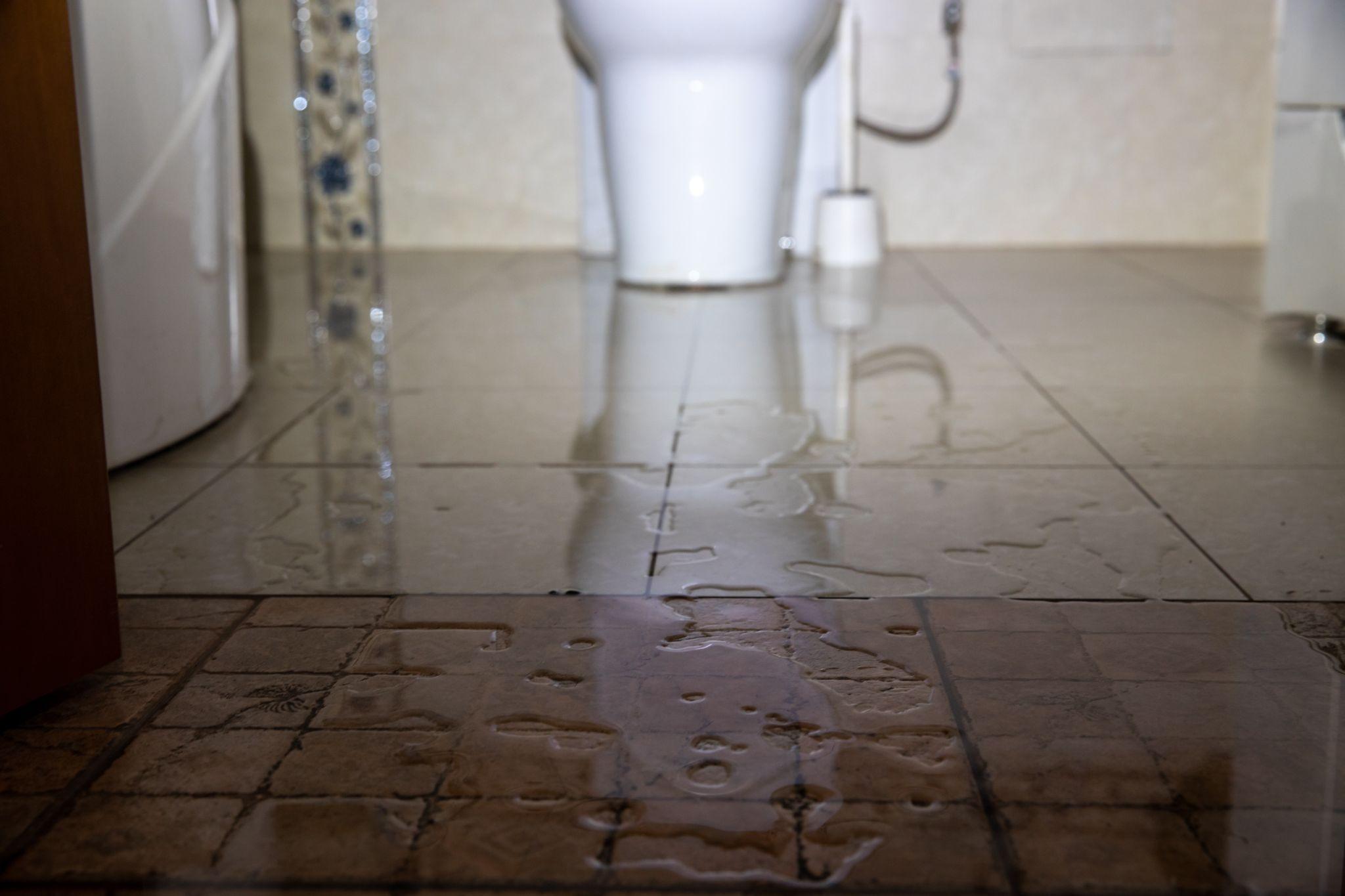
We have all experienced an overflowing toilet at some point. We flush the toilet, and the toilet water just keeps rising and rising until it is overflowing over the toilet bowl and onto the floor.

At this point, panic sets in because all that wastewater is flooding onto the bathroom floor. If we don’t stop the water, it could create an even bigger mess. The best thing to do is take a deep breath and use the following step-by-step instructions.

Step 1: Contain the Water

You need to contain the water and stop it from flowing across the bathroom floor. Grab some towels and put them down to contain the water around the toilet as best as possible.

Do not waste time getting paper towels or rags, as too much water could overflow onto the floor. You can wash the towels with bleach later, so you just need to grab whatever towels you can as quickly as you can.

Step 2: Shut Off the Water

Once the water is contained, you need to shut off the water if it is still overflowing from the toilet. At the base of the toilet in the back, underneath the tank, should be a water shut-off valve. Turn this valve until the water stops running.

Alternatively, you could remove the lid from the toilet tank and push the flapper inside down into the hole to stop the water. Another option is to lift the float fill valve to stop the tank from filling with water. You will need to find something to keep the float fill valve in place.

Step 3: Clean Up the Mess

Now that the water has been shut off, you can start cleaning up the excess water. Gather your cleaning supplies, including:

  • Rubber Gloves
  • Mop Bucket
  • Mop
  • Antibacterial Floor Cleaner

You need to first mop up the excess water off the floor. Wring the mop out in between to extract as much water as possible. Empty the mop bucket in the shower or bathtub.

Carefully pick up the towels from the floor and wring those out in the bathtub or shower. Using your mop bucket or another container, transfer the towels to your washing machine so that you can wash them with hot water and bleach.

After all the excess water is cleaned up, mix hot water with the antibacterial floor cleaner and mop the floor. If you don’t have an antibacterial floor cleaner, you can mix the hot water with chlorine bleach to kill bacteria and germs that were in the toilet water.

Step 4: Plunge the Toilet

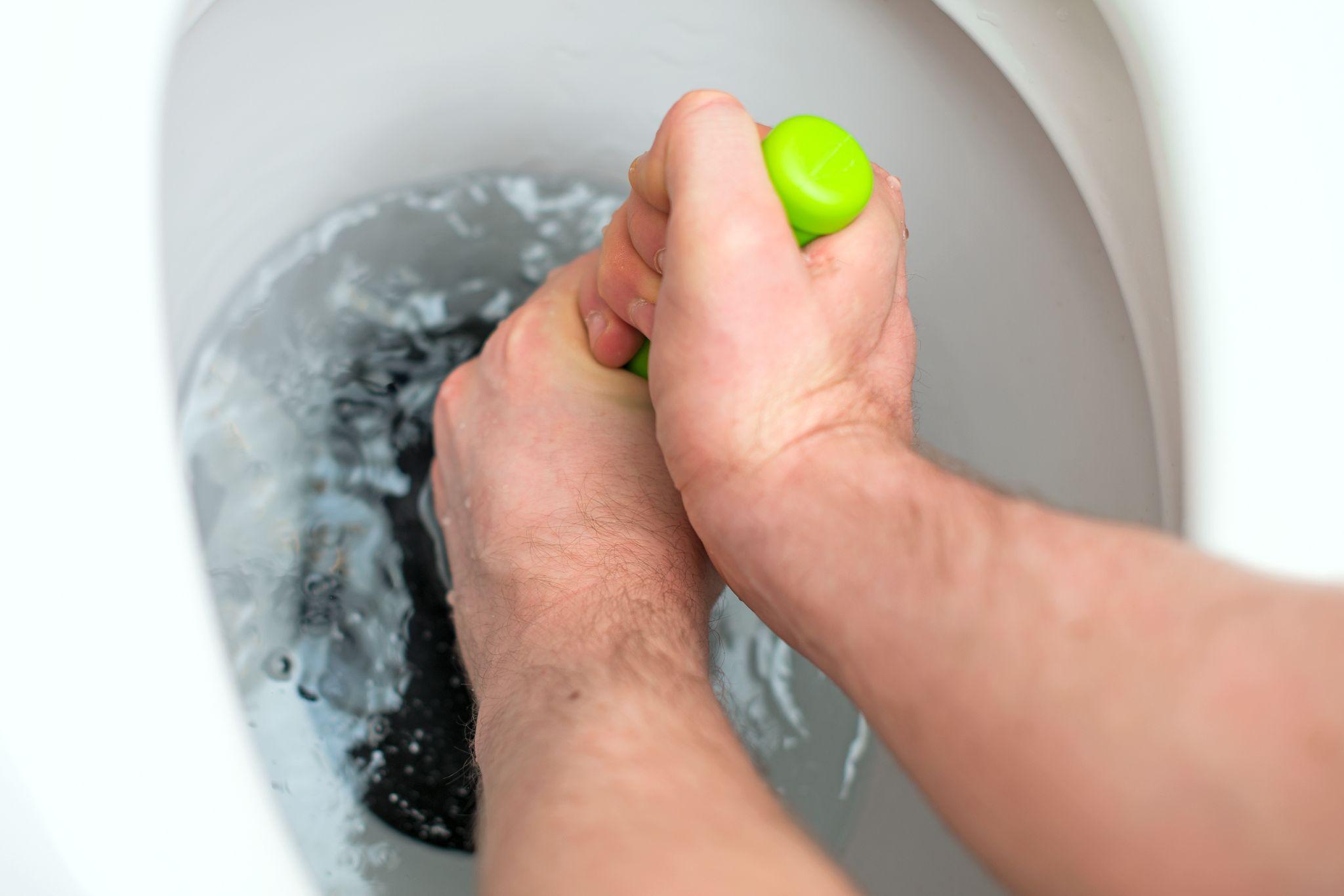
Plumber repairing toilet with hand plunger

You need to remove the clog that caused the toilet to overflow in the first place. Do not put chemicals or chemical-based clog removers down your toilet. Instead, use a toilet plunger to remove the toilet clog. Keep plunging until any excess water in the toilet bowl has drained out of the toilet.

Step 5: Place Towels Around the Toilet

As a precaution, place towels around the base of the toilet. Should the clog still be present and water starts backing up, you will at least have towels already in place if needed.

Step 6: Turn the Water Back On

Turn the water back on. If you shut off the water supply, turn the valve until water starts refilling the toilet tank. If you lifted the float fill valve, remove the object you held it up with so the toilet tank refills.

Step 7: Flush the Toilet

Keep your plunger nearby and flush the toilet. If the water level in the toilet bowl starts rising, start plunging to try to unblock the toilet clog. If the clog is too stubborn and the water level is nearing the top of the toilet bowl, shut the water off before it overflows.

If the water flushes down the toilet without any problems, the clog was removed. However, you will want to keep an eye on it for the next several flushes.

What could be causing your toilet to overflow?

Toilet overflow problems can be caused by various things, including:

  • Foreign objects that got flushed down the toilet like toys, batteries, and other small objects.
  • Flushing items in the toilet you are not supposed to, such as disposable diapers, paper towels, baby wipes, feminine products, etc.
  • Sewer and septic tank problems where the water backflows into the house up the toilet drains.
  • A broken or damaged sewer line.
  • Low water pressure that is insufficient to fully flush the toilet.
  • Overfilling the toilet bowl with too much toilet paper.

How do you prevent future overflows?

While certain plumbing problems, like sewer line and septic tank problems, cannot always be avoided, there are other things you can do to limit future toilet overflow problems, including:

  • Never flush anything in the toilet that should not be flushed.
  • Avoid using too much toilet paper.
  • If you have to use a lot of toilet paper, flush the toilet a few times to prevent overfilling it with too much toilet paper.
  • Have the toilet drain lines professionally cleaned by a plumber annually.

When should you call a plumber for toilet repairs?

smiling adult woman talking on phone

In situations where the toilet continues to overflow after you attempt to plunge it to remove the toilet clog, you will want to call a plumber. There could be a difficult clog or another sewer line or septic tank problem that needs to be fixed to resolve the overflowing toilet problem.

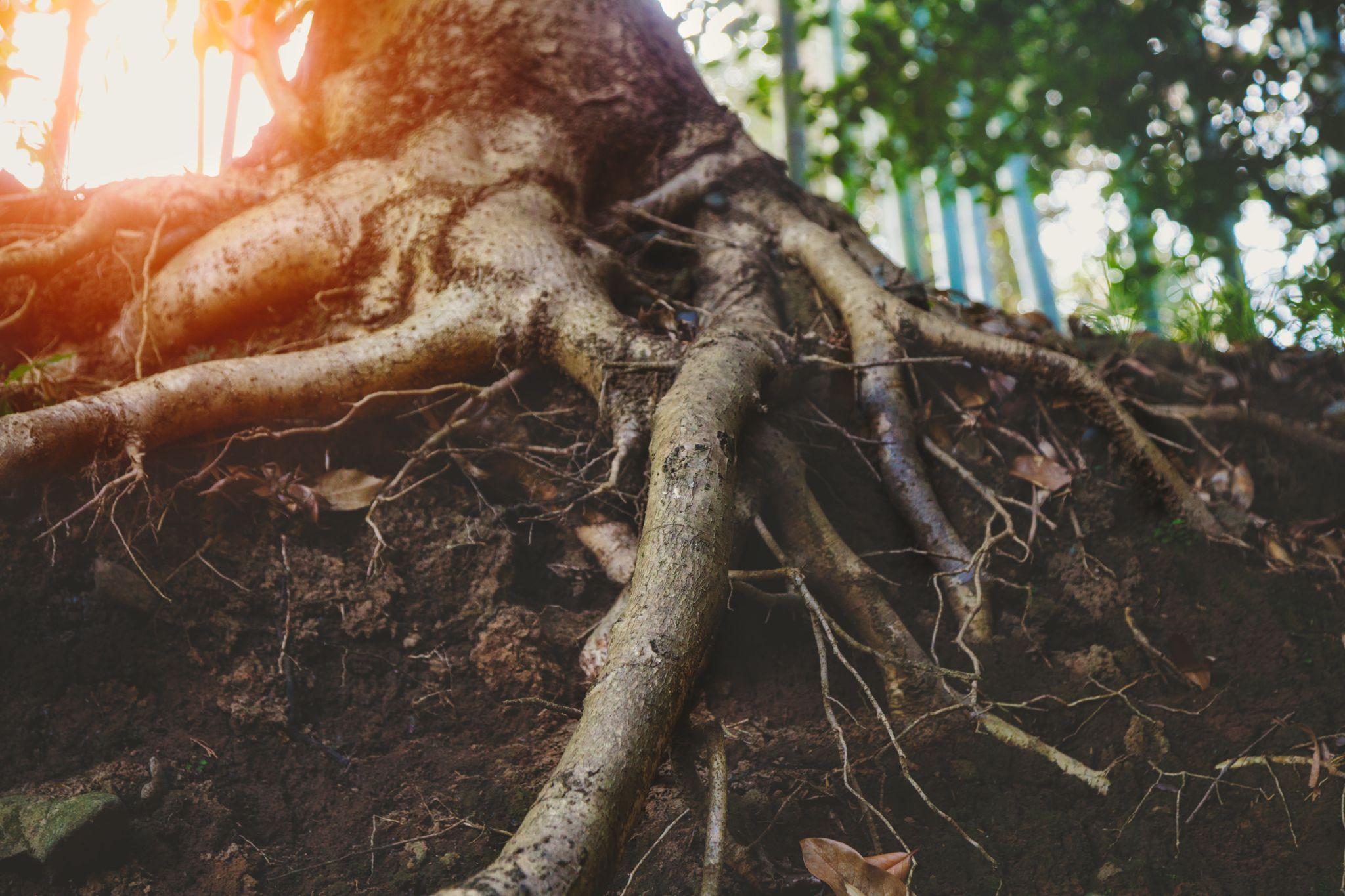
For example, tree roots are notorious for growing into sewer lines and creating clogs. The pressure from the tree roots could also cause the sewer line to crack and break, thus preventing water from draining away.

If you notice strange gurgling sounds when you flush the toilet that comes from another toilet, shower drain, bathtub drain, or kitchen sink drain, this is a common sign of a sewer line problem.

Additionally, you should call your plumber when the flow of water does not stop in between flushes. There could be a problem with the toilet flapper, float fill valve, etc.

For professional toilet drain cleaning, toilet repairs, and sewer line repairs in New Braunfels, Temple, San Antonio, and the Austin Metro Area, please feel free to contact Christianson Air Conditioning & Plumbing at 512-246-5400 today!


At What Temperature Should a Hot Water Heater Be Set?

Posted on September 24th, 2021 by ChristainSon_Admin

Plumber repairing an hot-water heater

You need to make sure your water heater is set at the right temperature. If it is set too high, the hot water could scald your skin. If it is set too low, it can allow the bacteria that causes Legionnaires disease to thrive and grow.

What is the ideal water temperature for my home?

While the plumber preset the temperature when your water heater was installed, it may not be the best temperature for your home. The maximum Department of Energy recommended water heater temperature setting you should never exceed is 140 degrees Fahrenheit. The lowest recommended setting should never be below 120 degrees Fahrenheit.

You can use the answers to the following questions to choose the ideal water temperature for your home.

  • Do you or does someone in your home have a suppressed immune system? If so, then set your water heater to 140 degrees Fahrenheit.
  • Do you have any infants, toddlers, or children in the home? If you do, then turn it down to between 120 degrees and 130 degrees Fahrenheit. At 140 degrees, it takes just seconds for your little ones to get third-degree burns.
  • Do you have a dishwasher with a pre-heat or water heating feature? If you do, you can turn it down to 120 degrees Fahrenheit.
  • How many people live in your household? If you live alone or with one other person, setting the temperature on your water heater to 120 degrees should be sufficient to meet your hot water needs. For a family of four, start at 120 degrees Fahrenheit and adjust it up in five-degree increments but do not go over 130 degrees Fahrenheit.

Water TankTemperature Setting

Another important consideration when setting the water temperature is the type of water heater you have in your house. If you have a water tank-type heater, never set it below 120 degrees unless you are on vacation and no one will be using hot water while away. Anything below 120 degrees allows bacteria to grow.

Tankless Temperature Setting

Since there is no standing water to worry about, you can set the water temperature slightly lower with a tankless heater. 120 degrees Fahrenheit is the recommended initial energy-efficient temperature setting. If you find the water temperature too hot, turning it down to 110 degrees Fahrenheit is acceptable.

How does the water temperature affect my energy bill?

On average, there is a 3% to 5% change in your monthly energy bills for every 10 degrees you adjust the temperature on your water heater. If you turn it down 10 degrees, then you decrease your energy usage and save money. If you turn it up 10 degrees, your energy bill will increase because you are using more energy.

How do I adjust the water temperature on my water heater?

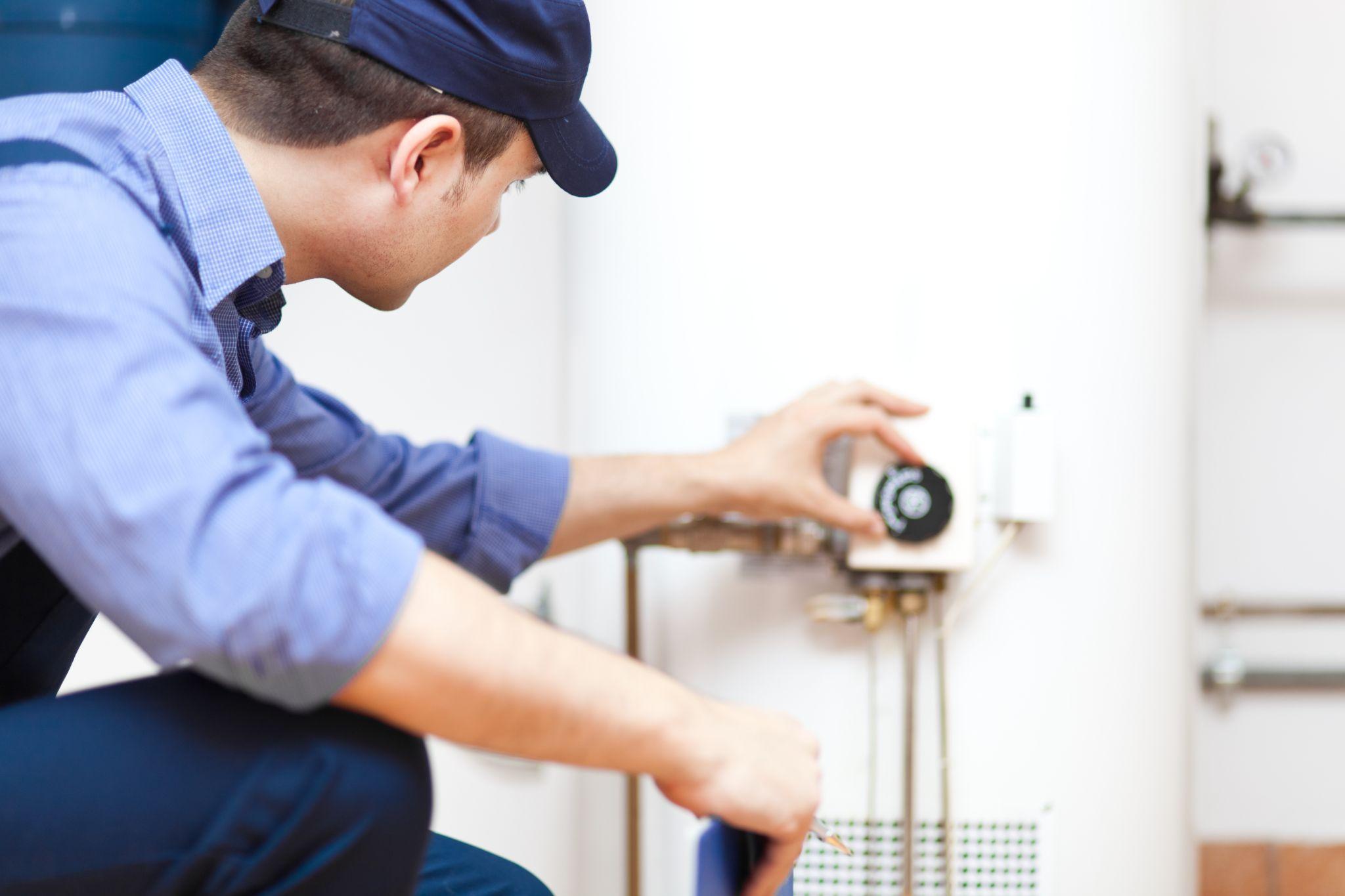
Smiling technician servicing a hot-water heater

For water tank heaters, there is a dial on the front of the water tank. Simply turn it down or up to adjust the settings. For tankless water heaters, there is a digital display on the unit. Setting the water temperature is as easy as changing the temperature on your thermostat.

What should I do if my water temperature is inconsistent?

If your water temperature is inconsistent, it does not seem like your water gets hot enough, or all that comes out of the hot water lines is cold water, it is time to call a professional plumber for help. Additionally, if your water heater is more than 10 years old, you may want to talk to your plumber about upgrading to a new energy-efficient water heater.

For help setting the temperature on your water heater, or for water heater repairs, maintenance, or new installations in Temple, New Braunfels, San Antonio, or the Austin Metro Area, please feel free to contact Christianson Air Conditioning & Plumbing at 512-246-5400 today!

Tags: , ,


Gas Water Heaters 101

Posted on August 27th, 2021 by ChristainSon_Admin

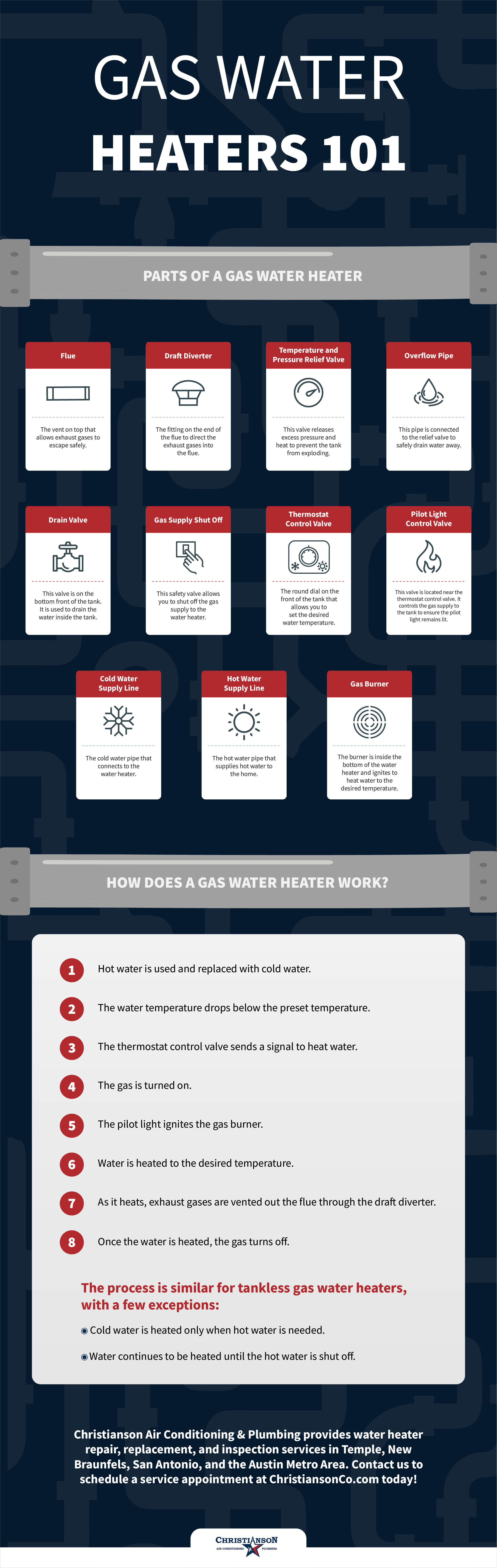
Gas water heaters help make hot water for showers, doing dishes, and washing clothes. Every homeowner should know several essential parts of a gas water heater to understand what they do. It is equally important to understand the basics of how a gas water heater makes hot water for your home.

The most common parts of a gas water heater are on the outside and include:

  • Flue
  • Draft Diverter
  • Temperature and Pressure Relief Valve
  • Overflow Pipe
  • Gas Supply Shut Off
  • Thermostat Control Valve
  • Pilot Light Control Valve
  • Cold Water Supply Line
  • Hot Water Supply Line
  • Gas Burner

Whether you have a tank-type gas water heater or a tankless gas water heater, you will find these common parts. There are parts inside, too, but they are ones your plumber needs to know about when performing water heater repair service.

To learn more about what each of the common parts of a gas water heater does, we invite you to continue reviewing the following infographic.

If you need water heater repair, replacement, or inspection services in Temple, New Braunfels, San Antonio, and the Austin Metro Area, please feel free to contact Christianson Air Conditioning & Plumbing at 512-246-5400 today!

Gas Water Heaters 101 Infographic

Click below to embed this infographic into your website:


AIR CONDITIONING MAINTENANCE TIPS TO HELP KEEP YOUR AC SYSTEM RUNNING EFFICIENTLY

Posted on August 24th, 2021 by ChristainSon_Admin

Young woman relaxing under air conditioner at home

On average in central Texas, an air conditioning system will last from 10 to 12 years. The service life can be shortened or extended, depending on how regularly preventive maintenance is performed. Maintenance will also help the system run more efficiently so that your home or office stays more comfortable and it costs you less money.

Regular maintenance ensures your system is more energy-efficient and requires fewer repairs, both of which save you money.

There is some maintenance you can do yourself, while other maintenance requires the service of an HVAC system expert. Professional maintenance should be performed on an HVAC system twice a year, once in the spring and once in the fall.

The following is a list of the tune-up, inspection, and services offered at Christianson Air Conditioning & Plumbing:

  • Thermostat calibration & setting – Ensure comfort when at home and save energy when you’re away.
  • Check & tighten all electrical connections – System will operate more safely and it will increase the life of components.
  • Lubricate all moving parts – Reduce energy by minimizing friction and overheating.
  • Check & inspect condensate drain – Plugged drains can affect indoor humidity levels and, more seriously, cause water damage.
  • Check all system controls – Ensure the system starts, operates, and shuts off properly.
  • Clean condenser coils – Dirty coils increase energy costs and reduce the life of equipment.
  • Check refrigerant levels & adjust if necessary – Too much or too little refrigerant increases energy costs.
  • Clean & adjust blower components – Airflow problems can reduce efficiency up to 15%.
  • (If applicable) Check all gas connections, gas pressure, burner combustion, and heat exchanger – Improperly sealed gas connections are a fire hazard. Dirty burners or failed heat exchangers can allow carbon monoxide to escape, which can be extremely unsafe or possibly fatal.

Do-It-Yourself Air Conditioning Maintenance

Changing air conditioning air filters is probably the part of air conditioning maintenance that most people are most familiar with. Still, many fail to keep records or follow up with routine filter changes. Not only is this one of the most important parts of do-it-yourself air conditioning maintenance, but it is also one of the simplest.

When dirt builds up on air filters, air flow is obstructed, preventing the system from working efficiently. Additionally, it lowers indoor air quality. So, if you have allergies or asthma, you can notice an increase in respiratory problems when you have a dirty air filter.

Either cleaning a reusable filter or replacing it with a new one can improve energy efficiency by as much as 15%. To aid in system efficiency and help extend the life of your system, Christianson recommends cleaning or replacing filters once a month.

The air conditioner coils absorb heat, making them an important part of the cooling system. They are also prone to collecting dirt, even when the filter is kept clean. When dirt covers the coils, they are unable to absorb heat efficiently. Indoor units should be examined visually each year, prior to air conditioning cooling season, and cleaned if necessary.

On the outdoor condensing units, the coils are even more vulnerable due to exposure to foliage, dust, and grass clippings. It is important to keep grass, weeds, bushes, and plants cleared and trimmed away from the condensing unit. It is also a good idea to treat around the unit’s concrete slab with pesticide to prevent ants and spiders.

You may recognize the area on the evaporator and condenser coils known as “coil fins” by sight more than by their name. These flat metal pieces are extremely fragile and easy to bend. Be very careful when mowing or trimming to not damage the coils. Bent coils reduce airflow dramatically and impact the efficiency and life of your system. If the fins become badly bent or damaged, contact a service provider or a Christianson expert to restore them to good operating condition.

Other DIY Air Conditioning Maintenance Tips

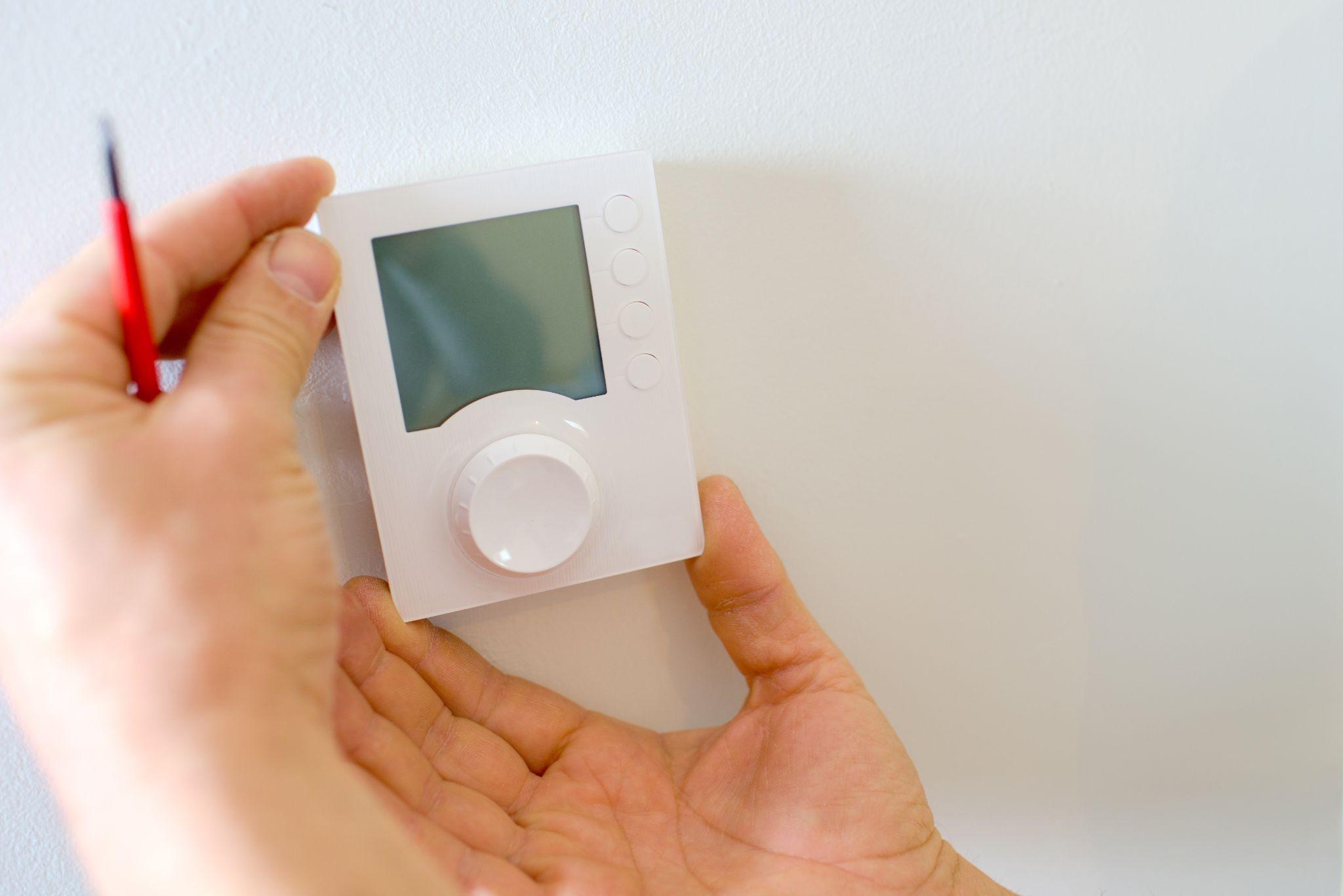
Electrician fitting a new thermostat

There are several other DIY AC unit maintenance you can do before scheduling HVAC maintenance, including:

#1: Upgrade Your Thermostat

Older thermostats are not as energy-efficient as programmable thermostats and smart thermostats. Smart thermostats are superior because they learn your routines and will automatically adjust temperatures based on those routines.

Additionally, you can access your thermostat from just about anywhere using an app on your smartphone. You can make changes to your settings, such as turning down the AC a few degrees when you leave work so your home is cooled to your desired temperature when you arrive.

#2: Clean the Drain Pan

Some air conditioning units have a drain pan that helps drain away water when the unit runs. Dirt, dust, and other debris can get into the bottom of the pan. Over time, as the water mixes with dirt and dust, it can create clogs in the drain line.

About once a month, check the drain pan to make sure it is clean. If it is dirty, wash it with a mild dish soap, rinse it, dry it, and put it back into the unit. Your AC technician can show you where the drain pan is the next time they perform AC maintenance.

#3: Verify the Outdoor Unit Is Level

The outdoor unit must be level in order for it to function correctly. If it is not level, the unit will still run but can lead to problems with condensation getting under the evaporator and making the insulation wet. Should this occur, then all the insulation has to be replaced since wet insulation no longer provides any resistance.

Not to mention, the wet insulation becomes a breeding ground for mold and mildew. When the AC runs, it will not only increase the humidity inside the house but also make it smell.

#4: Check the Drain Pipe on the Outdoor AC Unit

When the air conditioner runs, it will produce water as it cools hot air. The water should drain out a drain pipe on the side of the unit. If you notice the water is not draining properly, carefully remove the drain pipe and run hot water through it to remove any clogs.

Other DIY Tips to Improve Your Home’s Energy Efficiency

Aside from keeping up with air conditioning maintenance, there are several other things you can do to improve your home’s energy efficiency to keep it cool in summer and warm in winter, as follows:

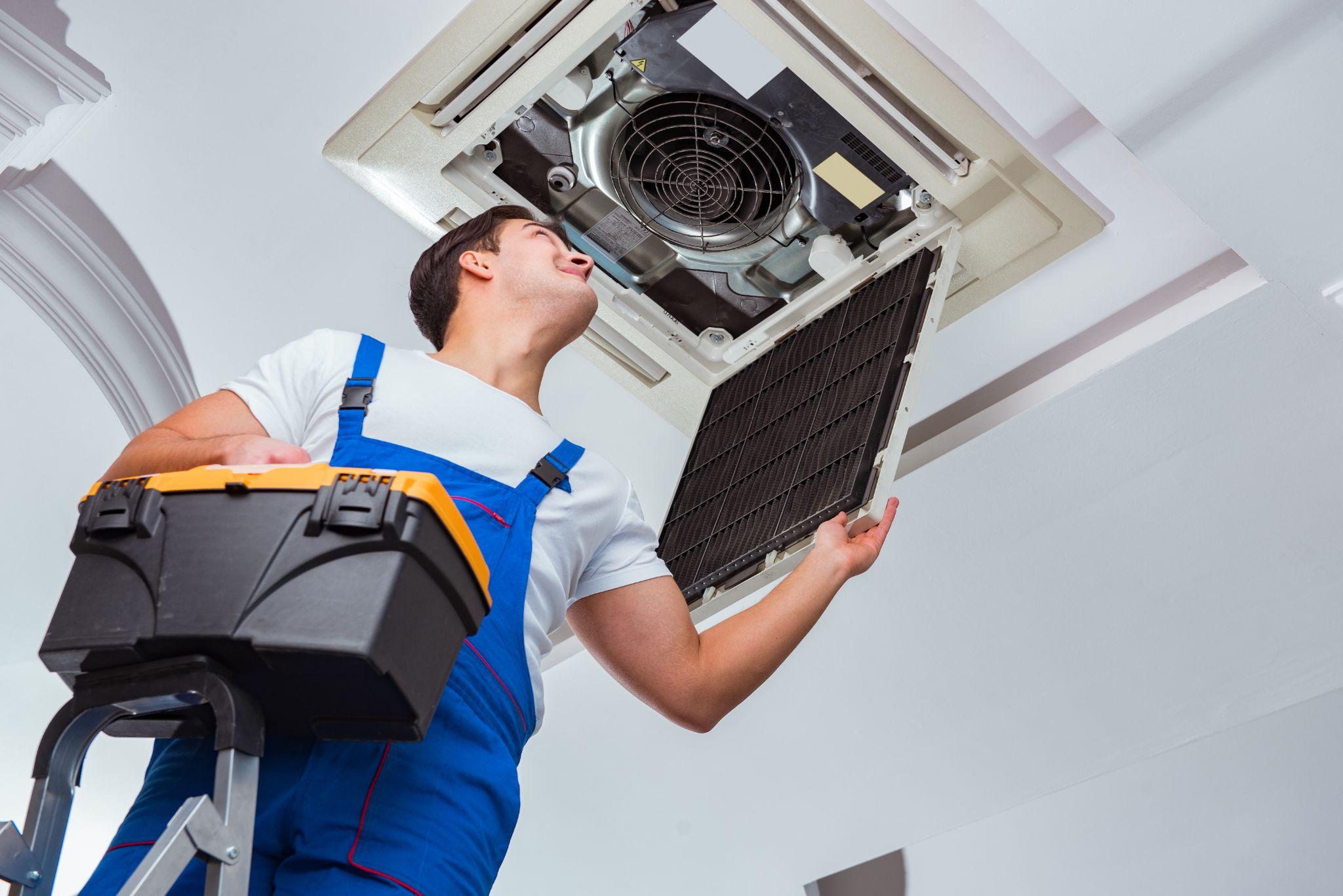
Worker repairing ceiling air conditioning unit

  • Recaulk Around Windows – You should replace the old caulk annually to help prevent air leaks around windows.
  • Replace Door Seals – Inspect the door seals around doors and replace anywhere you can see light coming in around the door.
  • Block Direct Sunlight – Use thick curtains or thick blinds to block out direct sunlight on sun-facing windows.
  • Replace Your Windows – Upgrading to energy-efficient windows does improve the overall energy efficiency of your home.
  • Add Attic Insulation – Another easy DIY project is to increase the amount of insulation in your attic.

Leave It to the Pros

Although some minor maintenance can be performed by the homeowner or business owner, a maintenance plan with Christianson Air Conditioning & Plumbing includes all the annual and bi-annual maintenance that will keep your HVAC system running more efficiently. These services include two precision system tune-ups annually: one in the spring and one in the fall.

Your air conditioning is a vital component of your comfort and utility bill. Don’t leave its efficiency to chance. Call Christianson Air Conditioning & Plumbing in Austin at (512) 246-5400 or our San Antonio location at (210) 651-1212 to schedule your maintenance services before hot weather rolls around.


Is a New HVAC Unit Tax Deductible?

Posted on July 24th, 2021 by ChristainSon_Admin

Ac air appliance change checking clean condition

Energy Star equipment tax credits for residential homeowners were extended by the IRS through December 31, 2021. Taxpayers who make qualifying home improvements before the end of 2021 can claim a tax credit when they file their 2021 tax returns.

Included in the eligible tax credits are certain HVAC systems that meet specific qualifying requirements when you have a new system installed by a professional heating and cooling company. There are two specific qualifying conditions you must satisfy to be eligible for a federal tax credit, as follows:

#1: The new air conditioner must be installed at your primary residence.

You can only qualify for the tax credit when the new system is installed in your primary residence. For most people, this will be their existing home. If you own more than one home, only the one you use as your primary residence qualifies for the tax credit.

#2: The new air conditioner must meet energy-efficiency improvement requirements.

The new HVAC system must meet the required energy efficiency rating. Energy efficiency ratings are determined by the type of system you have installed. It is highly recommended you review what systems qualify for the energy property tax credit with your HVAC installer to ensure you select an eligible unit.

How Much Is the Energy Efficiency Tax Credit Worth?

The maximum amount of the energy efficiency tax credit will vary depending on the type of system installed. You could qualify for a tax credit if you have one of the following HVAC systems installed in your home:

  • Gas Furnace
  • Split System Heat Pump
  • Packaged AC System
  • Heat Pump/Dual Fuel Systems
  • Central Air Conditioning Split Systems
  • Gas Furnace or Packaged System with an Advanced Main Air Circulating Fan

Qualified home improvement HVAC system installations can earn tax credits ranging from $50 to $300. However, some homeowners may qualify for 10% of the installed costs up to $500 maximum. You can also get incentives and tax credits on other home renovation projects like solar electric gadgets, clean energy, electric vehicles, smart home, etc. If you clear for any of these programs, you can search for a tax accountant near me and consult a reputable company to help you file for personal taxes and rebates.

Why Does This Home Improvement Incentive Exist?

In efforts to get homeowners to make energy-efficient home improvements, the federal government rolled out the incentive program back in 2006. Since that time, they have continued to renew the program, extending its expiration date. Originally, the program was slated to expire on December 31, 2020. However, it was extended for another year.

There is no guarantee the program will be extended beyond 2021. Furthermore, each time the program is extended, the amount of qualifying energy-efficiency tax credits have been gradually reduced. So, if you have been thinking about having a new HVAC system installed and want to take advantage of the federal tax credits, now is the perfect time.

Aside from the energy property tax credits for HVAC systems, there are tax credits for qualifying water heaters as well. You can combine tax credits up to the maximum $500 amount.

How Do You Claim This Tax Credit?

Accountant working with US tax forms

To claim the energy-efficient home federal tax credit, you need to fill out IRS Form 5695 and complete Form 1040 when preparing your federal income tax return. If you use a tax preparation software or application, make sure to select that you need to fill out Form 1040.

The application should prompt you by asking questions about energy-efficiency improvements you made to your home. If you have a tax accountant prepare your tax return, simply let them know you want to claim this tax credit on your 2021 tax return.

Find Out How Much You Could Qualify For

If you want to find out how much you could qualify for when you have a new HVAC system installed in your home, please feel free to contact Christianson Air Conditioning & Plumbing. Call us at 512-246-5400 to schedule an in-home consultation in New Braunfels, Temple, San Antonio, or the Austin Metro Area today!

We can also provide you information about water heater replacements that qualify for federal tax credits.

Tags: , ,


10 Signs Tree Roots Are Growing in Pipes

Posted on July 22nd, 2021 by ChristainSon_Admin

Split drainage pipe caused by ingress of tree roots

Most homeowners in Texas will have trees on their property to help provide shade, especially on those hot summer days. However, while trees provide shade, they can cause problems with your home’s water and sewer pipes. If you are a property developer or invest in property through resources such as Lincoln Frost, for example, and you want to make sure your properties are safe for your residents, especially as you have money invested into these pieces of land, then you want to make sure that you have a thorough inspection of the surrounding area on occasion to see if there are any issues, like roots growing in the pipes.

When roots get in pipes, it is essential to resolve the problem sooner than later. Otherwise, you end up with more plumbing problems and repairs to fix.

How do tree roots grow in pipes?

Tree roots seek out moisture to provide water for the tree. In general, most tree root systems are about three times larger than the height of the tree. So, if you have a ten-foot-tall tree, the root system is roughly thirty feet long!

The root system also extends over a wide area under the ground to help keep the tree in place. When water leaks develop in water pipes and sewer pipes, tree roots are attracted to it. Very small parts of the tree root can grow into tiny cracks and openings in the plumbing pipes to get to the water.

As the roots get inside the pipe, they gradually become bigger and bigger. Eventually, their size can cause water and sewer pipes to become obstructed and prevent the flow of water and sewage. Most people tend to hire experts from a Tree Removal service in their area to get rid of the tree even before the roots do the damage. Once the tree has been cut down, the roots eventually die down.

People go for this option as the larger roots can cause the pipes to crack and break. Depending on whether it is your water line or sewer line that cracks and breaks, you may not notice right away, unless you know what signs to watch for that could indicate tree roots are in the pipes.

How fast do tree roots grow in sewer pipes?

All tree roots see out water, oxygen, and nutrients to help the tree thrive and grow. The roots will grow in any direction necessary, including into sewer pipes. Most tree roots grow the most from spring through fall.

How fast tree roots grow in sewer pipes is much faster than growing in the dirt. Since the roots have access to a constant supply of water, oxygen, and nutrients in the sewer line, not only will the tree thrive and look very healthy, but the root system will expand and grow much quicker.

In general, depending on the size of the sewer line, it could take anywhere from a year to three years before the roots completely clog the sewer line. The smaller the pipe’s diameter, the faster it will clog.

With water lines, the rate of growth is about the same. Initially, when tree roots first enter sewer or water pipes, most people will not notice anything until something goes wrong with their home’s plumbing.

What signs should homeowners watch out for?

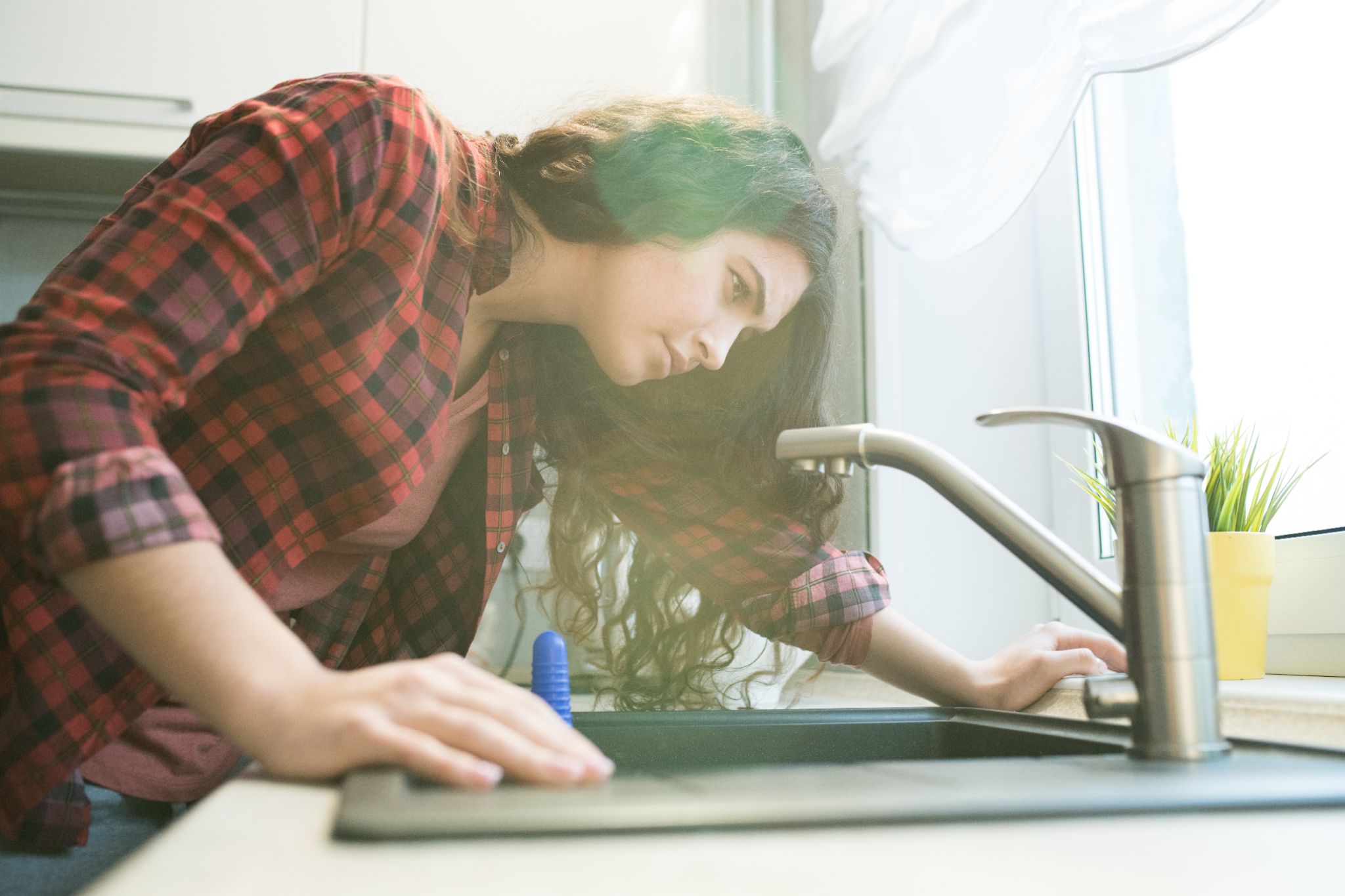
young woman checking faucet while having problem with dropping faucet in kitchen

Sign #1: Strange Odors

If you notice strange odors coming from drain lines, it might indicate a tree root problem. However, it could also indicate there is yucky stuff inside the drain pipes that just need a professional drain cleaning to remove.

Sign #2: Water drains away slowly.

Slowly draining drains could indicate tree roots in the sewer lines. Yet again, it could also be a problem that requires a drain cleaning service to clean away accumulated deposits inside the drain pipes.

Sign #3: Toilets have lost their “oomph.”

When you flush the toilet and the water seems not to go down as powerfully as it used to, it might indicate that tree roots are growing inside sewer pipes. A clog could also be developing if you flushed down items you shouldn’t have in the toilet like paper towels, tissues, or baby wipes.

Sign #4: You hear gurgling coming from drains or toilets.

When water is draining down one drain line, you might notice gurgling sounds coming from other drains in the home or the toilets. You might also hear these sounds when you flush a toilet.

Sign #5: Toilets back up when flushed.

When you flush the toilet, it could back up, or other toilets in the home could back up if there are tree roots in your sewer line.

Sign #6: Your water bill increases unexpectedly.

If you notice your water bill is increasing, yet you are not using any more water than usual, this could indicate tree roots have grown into your main water line. However, this sign could indicate there are water leaks as well.

Sign #7: You notice parts of your yard are sinking into the ground.

Leaks from sewer and water lines when tree roots have damaged them can cause the ground to become overly saturated with moisture. Eventually, the weight of the wet soil causes it to sink into the ground.

Sign #8: You notice certain trees are growing more quickly than other trees in your yard.

If a few of the trees on your property look greener and have a lot more new growth than others, this often indicates that they have found a steady source of water, typically from sewer or water lines.

Sign #9: You notice a drop in water pressure.

Water pressure will not drop unless there is an obstruction of some sort. When tree roots grow into water supply lines, the blockage will cause water pressure to drop.

Sign #10: You notice pipes are making a banging noise or whistling noise.

When you turn on the water, flush the toilet, or drain the tub or a sink full of water and hear banging noises or whistling noises, this could indicate the water pipe or sewer pipe has been cracked or crushed, allowing air to flow into the pipe.

Tree Roots in Pipes Removal

service man, plumber or electric

Several different tree roots pipe removal options are available, depending on the extent of the problem, as follows:

Sewer Root Removal

Small tree roots can be removed using a special pipe auger that cuts the roots away and clears the clog from the sewer pipe or water pipe. However, this is a temporary solution to the problem. The same leaks and cracks that allowed the tree roots inside the pipe will remain. So, the problem will return again.

Sewer Pipe Lining

Sewer pipe lining is a more permanent solution to tree roots in pipe problems. The tree roots are removed first using sewer root removal processes. Once the roots are gone, a pipe lining is inserted inside the existing pipe. Even though there are cracks and leaks in the original pipe, the new pipe lining blocks those to prevent tree roots from returning.

Sewer Pipe Bursting

Sewer pipe bursting is another minimally invasive way to fix sewer and water lines that tree roots have invaded. This method is also a permanent solution that is better to use when the pipes have extensive cracking and breaking.

The new sewer pipe is connected to a winch. A special pointed-head is put on one end of the new pipe. It is then pulled through the existing line, clearing out the tree roots and damaged sections to create a new section of pipe fitted to the existing sewer or water line.

Sewer Line Replacement

The final option to eliminate tree roots from water and sewer lines is to replace the existing pipe with a new one. This process requires digging up larger sections of the yard to have full access to the sewer line or water line.

The old sewer line or water is removed from the ground, along with the tree roots in the pipes. Next, a new section of sewer line is installed and connected on both ends to the existing line. Sewer line replacement is also a permanent solution to tree root problems.

To determine which tree root pipe removal option is best, a camera inspection should be performed first. Camera inspections help determine where the obstructions are located. They allow you to find out if tree roots are the problem or if you simply need a professional drain cleaning service instead.

If you suspect tree roots might be growing into your water and sewer pipes, you will want to contact Christianson Air Conditioning & Plumbing to schedule a camera inspection as soon as possible.

After we conduct the inspection, we will advise on the problem and make recommendations on how to resolve it. Please feel free to call us at 512-246-5400 to schedule an appointment today! We can also take care of your other plumbing or air conditioning problems in New Braunfels, Temple, San Antonio, or the Austin Metro Area.


How to Prevent Water Damage in Your Home

Posted on July 8th, 2021 by ChristainSon_Admin

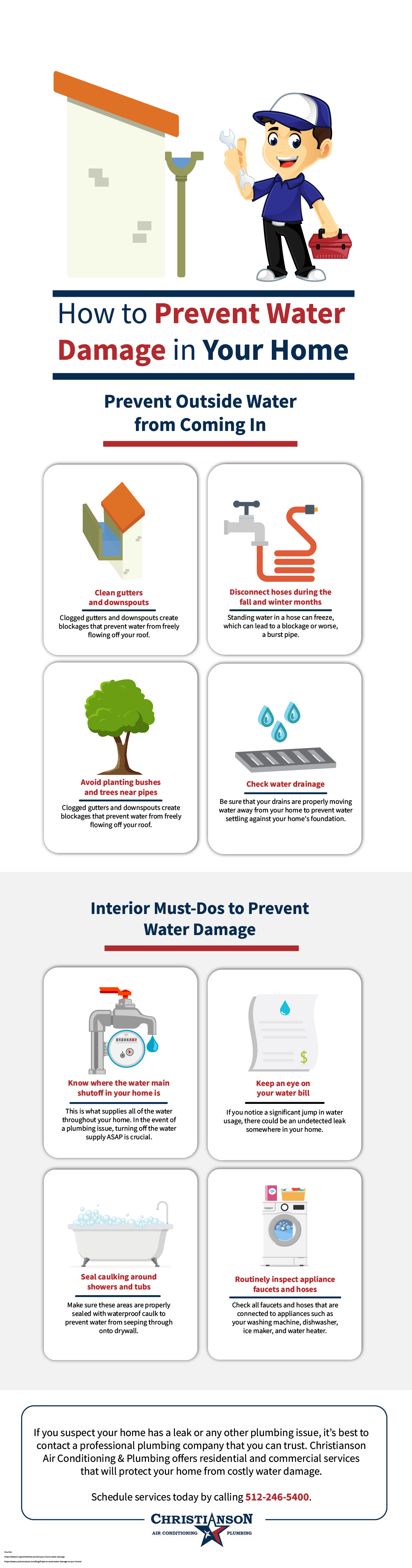
As a homeowner, it’s important to know how to prevent water damage in your home. Water damage does more than make things wet. Excess moisture on any surface can lead to mold and mildew, and some can be harmful to your health. Water damage can also cost tens of thousands of dollars to fix. Unfortunately in some areas, water damage could be a recurring issue due to weather changes, that is why restoration businesses are in high demand and will use resources like restoration marketing to get their name out there for homeowners to use during these times. They will always be needed so these types of companies are a necessity.

When it comes to water damage prevention, there are external and internal factors to consider. On the outside of your home, remove all debris from gutters and downspouts. It’s also important to disconnect hoses, especially during the colder months, as the standing water can freeze. This increases the risk of a blockage or burst pipe.

When beautifying your home, avoid planting bushes, trees, and thick-rooted plants near pipes. Eventually, the root system could wrap around and break underground pipes.

Most importantly, keep an eye on water drainage. When it rains, water should be moving away from your home. Otherwise, you risk water puddling against your home’s foundation.

There are also some interior things you can do for successful home water damage prevention.

Make sure everyone in your household knows where the water main shutoff is located. In the event of a plumbing problem, turning off the main water supply is critical in minimizing water damage.

Unsure if you have a plumbing issue? Keep tabs on your water bill. An unexpected jump in water usage could mean you have an undetected leak.

Ensure that your showers and bathtubs are properly sealed using waterproof caulk. This prevents water from seeping through onto the drywall.

It’s also important to regularly inspect your appliance faucets and hoses. Make sure that there are no leaks coming from your dishwasher, ice maker, washing machine, or water heater.

If you suspect you have a leak or an undetected plumbing issue, or if you need water damage cleanup and restoration services, look no further than Christianson Air Conditioning & Plumbing. Our team of experts use state-of-the-art tools and techniques to protect your home from water damage.

How to Prevent Water Damage in Your Home Infographic

Click below to embed this infographic into your website:


Copyright © 2025 Plumbing & Air Conditioning Company - Austin, TX

Licenses M-18631, M-18632, LI15740, TACLA023749C

Regulated by The Texas Department of Licensing and Regulation

P.O. Box 12157, Austin, Texas 78711, 1-800-803-9202, 512-463-6599, Website: http://www.tdlr.texas.gov